

Quick Answer: What Is Chinese Sugar Painting?
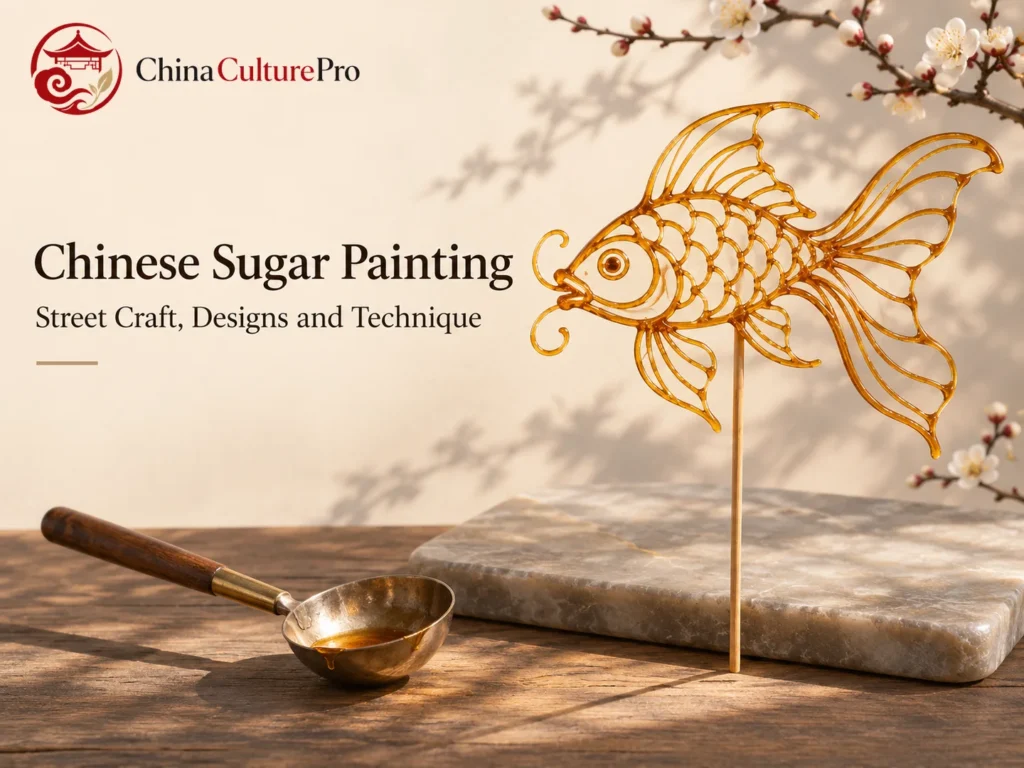
Chinese sugar painting (糖画, tánghuà) makes an edible image by pouring melted sugar in lines onto a smooth surface. A maker guides the flow with a ladle. The sugar sets into a thin shape that can be lifted, often with a stick attached.[1][2][3]
- Material: The sugar forms the picture itself.
- Shape: Lines and broader patches can make animals, plants and figures.
- Setting: The making is often visible at stalls, fairs and public craft demonstrations.
Poured pictures and blown figures are two different ways to work with sugar.
At a sugar painting stall, a narrow stream from a ladle becomes the outline of a fish or bird. The design has to read clearly from the front and hold together when lifted. Both demands shape the maker’s movements.
How a Stream of Sugar Becomes a Drawing
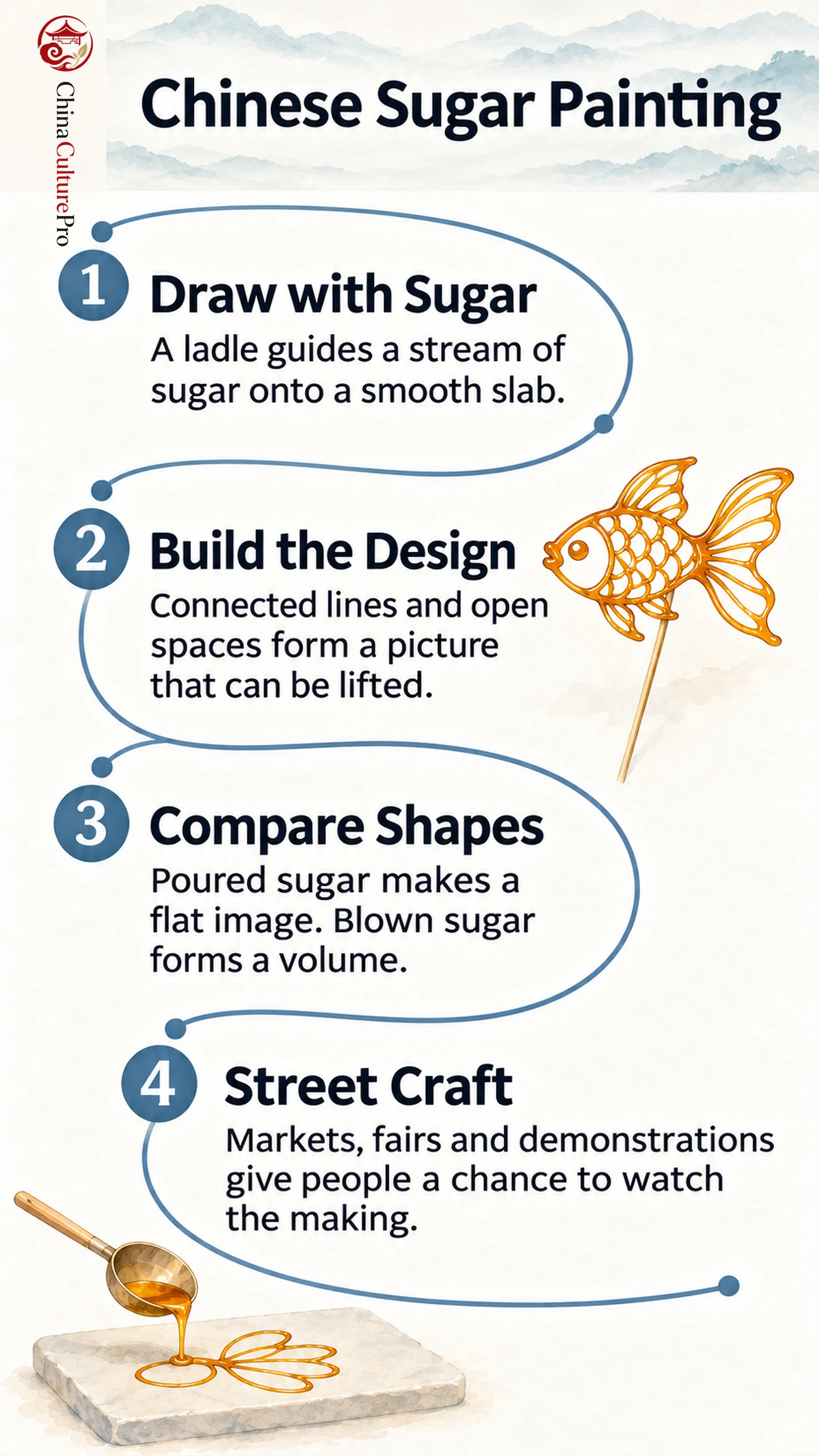
The ladle guides a stream onto a smooth stone slab. The width of the flow and the movement of the hand affect the line left behind. The maker can let sugar collect in a broader patch or keep it moving in a narrow line. As the line cools on the slab, the maker has to judge where to join the next part of the image.[2][3]
The slab supports the drawing as it sets. Once the piece holds its shape, the maker can release it with a small flat tool. On the slab, even a disconnected line can stay in place. Once the picture is lifted, the parts that belong to the main design have to stay attached.[3]
The tool makes a different mark from a brush. A line has thickness as well as width, and the material itself forms the finished image. Where two lines meet, the joint is both part of the drawing and a physical connection.[1][2]
Designs, Open Spaces and a Bamboo Stick
The Chengdu inventory documents birds, fish, insects and opera figures. A strong outline makes a subject recognizable. Smaller lines can suggest scales or feathers. The open spaces remain visible between these lines. The inventory also notes relationships with paper cutting and shadow puppetry, crafts in which edges and silhouettes do much of the visual work.[1]
A bamboo stick gives the finished picture a handle. The attachment sits against a part of the design that can carry it. Openwork lines can be delicate, so a maker has to balance clear spaces against the need for connected parts. On a fish, for instance, a strong outer line can carry finer lines that suggest scales. The stick meets a part of the design sturdy enough to carry the rest.[1][3]
Sugar Painting vs Blown Sugar Figures
The Chinese heritage inventory groups several techniques under sugar sculpture (糖塑, tángsù). Poured sugar painting and blown sugar figures (吹糖人, chuī tángrén) can use related materials while producing different shapes.[1][4]
| Technique | How the shape forms |
|---|---|
| Sugar painting | A stream of sugar draws a generally flat design on a smooth surface. |
| Blown sugar figures | Air expands a mass of workable sugar to create volume, which the maker can shape. |
The Tianmen tradition in Hubei gives a documented example of blowing and shaping figures. Another fairground craft, dough figurines, models a different material by hand. A fish can be drawn in sugar, blown into a volume or shaped from dough. Look for the way the body was formed before using the subject to name the craft.[1][4]
Chengdu Street Craft and Public Demonstrations
Chengdu sugar painting entered China’s national intangible cultural heritage inventory in 2008. The entry describes making and selling the pieces in settings such as markets and temple fairs. The record for Fan Deran (樊德然, Fán Dérán) also documents individual strengths, including opera figures and different ways of filling an image.[1][6]
Fan’s biography gives one way those subjects developed. He learned from another sugar painter and traveled with his teacher in settings that included Sichuan opera troupes. The record credits him with combining broad areas of sugar and flowing lines in his character designs. He later taught apprentices of his own.[6]
Some stalls use a spinner to select the subject. A documented market demonstration in Shidian shows children spinning for a design before the maker draws it with a ladle. The spinner turns choosing the design into part of the stall visit. The drawing still depends on how the maker controls the sugar.[5]
Watching a stall also reveals decisions that a still photograph can hide. You can see which part of the subject the maker draws first and where the stream slows to broaden a shape. The finished sweet preserves the lines, while the demonstration shows the order and movement behind them.[2][5]
FAQs About Chinese Sugar Painting
Is Chinese sugar painting edible?
The traditional picture is made from sugar and can be eaten. The bamboo stick serves as a handle.
Do all sugar painters use a spinner?
A spinner is documented at some stalls and demonstrations. The subject can be chosen in other ways, and the drawing still depends on the maker’s control of the stream.
Is a sugar painting the same as a blown sugar figure?
Sugar painting draws a generally flat image. In blown sugar work, air helps form a three-dimensional figure.
Is Chengdu sugar painting listed as intangible cultural heritage?
Chengdu sugar painting entered China’s national representative inventory in 2008 under sugar sculpture. That is a domestic listing for the practice.
Fuentes
[1] China Intangible Cultural Heritage Digital Museum. Sugar Sculpture: Chengdu Sugar Painting
[2] Beijing Municipal Government. Heritage Renewed, Values Shared: Sugar Painting
[3] Huaihua Municipal Bureau of Culture, Tourism, Radio, Television and Sports. Documenting Sugar Painting
[4] China Intangible Cultural Heritage Digital Museum. Sugar Sculpture: Tianmen Sugar Sculpture
[5] Shidian County Government. Folk Crafts at a Shidian Demonstration
[6] China Intangible Cultural Heritage Digital Museum. Fan Deran