


Quick Answer: What Is Chinese Silk Weaving?
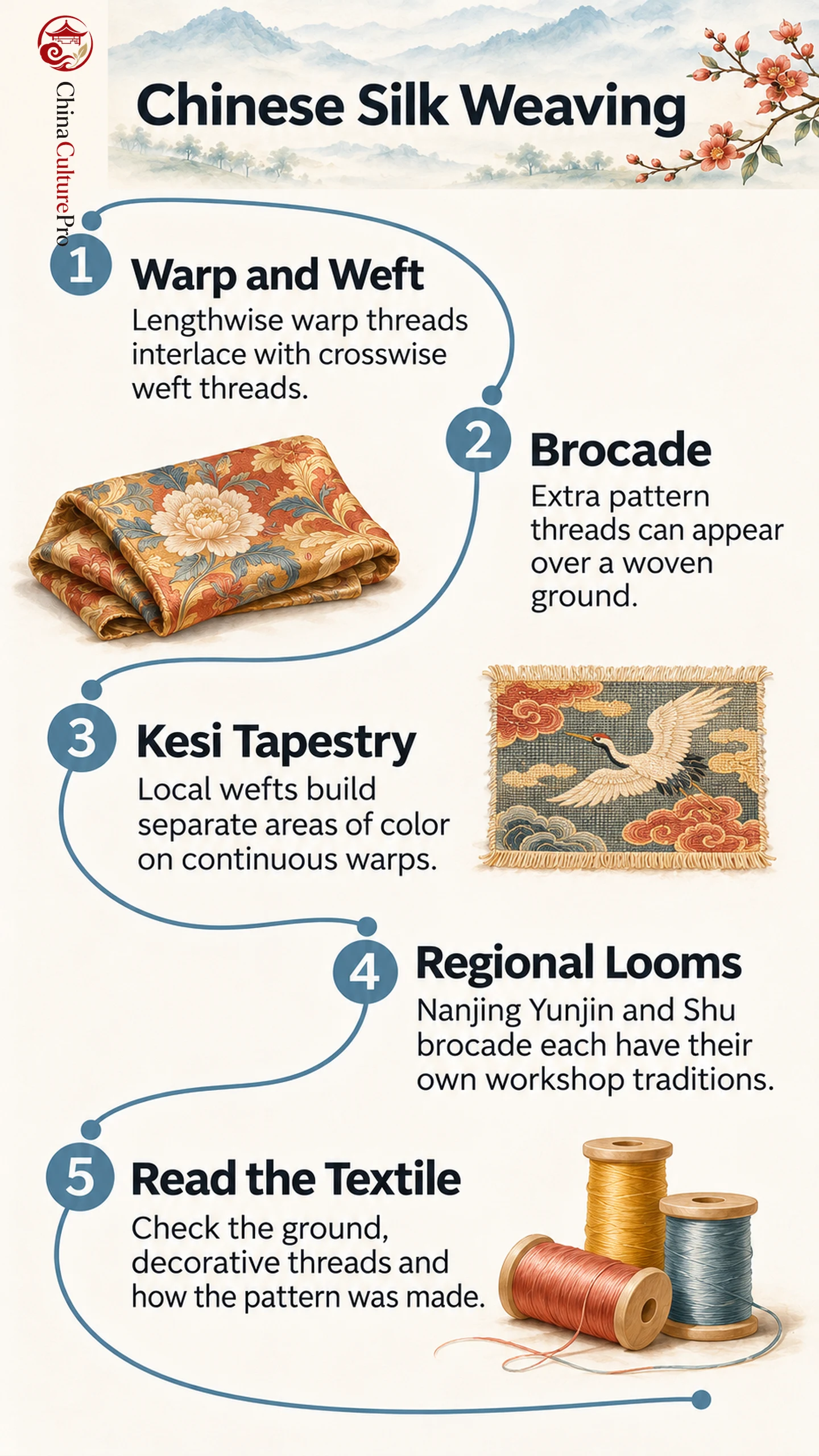
Chinese silk weaving makes cloth by interlacing threads. Some fabrics form patterns through additional threads woven into a ground, while others use different wefts to build areas of color. Kesi (缂丝, kèsī) is a silk tapestry technique in the second group.[1][2][3]
- Structure: The warp runs along the loom. The weft crosses it.
- Pattern: Brocade and tapestry can both be elaborate, but their threads do different jobs.
- Local practice: Named traditions also refer to people, places and ways of working.
Start with how the pattern is formed before drawing conclusions from its subject or color.
The front of a patterned silk can look like an embroidered picture. The difference lies in what the threads do. Read the cloth’s structure first, then use an object record to identify the material, the technique and any documented regional connection.
From Silk Thread to Warp and Weft
The work can begin long before the loom. The UNESCO entry on sericulture and silk craftsmanship describes mulberry cultivation, silkworm raising, reeling, thread preparation and weaving. Sericulture concerns producing silk. Weaving begins once threads are prepared, and it belongs to a wider set of processes in Chinese traditional crafts.[1]
Warp threads are set under tension on the loom. Weft threads cross through openings between selected warps. How those threads interlace affects the fabric’s surface. To understand a pattern, ask whether it is formed by the threads of the cloth itself, by additional pattern threads or by stitches added later.[7]
How Brocade Adds Pattern to the Cloth
In one common brocade construction, a ground weave forms the cloth and additional weft carries a motif. This extra thread is called supplementary weft. A pattern thread can cross the whole width or work within a limited area, depending on the construction. The ground and decorative threads can have different materials and finishes.[2][7]
An eighteenth-century textile with a floral scroll in the Met collection has a satin ground and supplementary-weft patterning. In the flower centers, strips of gilded paper wrap around silk cores. The material entry describes the satin and its woven pattern, while the object description explains what gives the flower centers their sheen. The color word “gold” therefore describes only part of the thread’s construction.[2]
How Kesi Weaves Separate Areas of Color
In kesi silk tapestry, warp threads continue along the fabric while colored wefts work in separate areas. A color can turn back at the edge of a motif instead of running across the entire width. Narrow slits may appear where adjacent areas meet. Other joins can connect neighboring wefts, so a slit need not appear at every boundary.[3][7]
The reverse can show details the face conceals. Surviving tapestries include examples with weft ends visible on the back and pieces whose ends were wrapped and trimmed carefully. A clean reverse can therefore reflect finishing choices as well as how the design was woven.[7]
A twelfth-century scroll cover in the Met collection is made from silk and metal-thread tapestry. The record describes how it came to the museum as the cover for a handscroll. The cover was part of the experience of opening the scroll. The record describes that documented use without establishing when it was first paired with the painting.[4]
Nanjing Yunjin and Sichuan Shu Brocade
The documented tradition of Nanjing Yunjin (云锦, yúnjǐn) uses two people on a large loom. Pattern preparation includes planning how warp threads will be selected. The workers coordinate across the upper and lower parts of the loom. The UNESCO description also records songs that help them remember the sequence. Court dress and modern reproductions show different applications of Nanjing Yunjin weaving.[5]
In Sichuan, the published account of Shu brocade (蜀锦, shǔjǐn) describes pattern preparation and fitting the loom before weaving. It also records distinct jobs for lifting selected warps and passing the shuttle. Read the guide to Shu brocade for the regional context. The broader living heritage entry on sericulture and silk craftsmanship also documents family teaching and apprenticeships.[1][6]
How to Read a Woven Textile in a Collection
| Process | How the pattern is formed |
|---|---|
| Supplementary-weft brocade | A ground cloth is woven with additional pattern threads. |
| Kesi tapestry | Localized wefts build color areas across continuous warps. |
| Bordado | Decorative stitches are added onto an existing ground. |
In museum collection records, read the ground, decorative material and patterning terms separately. A floral motif or metallic shine might appear in several kinds of textiles. Start with a close image if one is available. Look for the edges of color areas and for decorative threads that sit over the ground. The reverse, when documented, can make the path of a thread clearer. The guide to Chinese embroidery shows how the same distinction works when stitches sit on a woven ground.[2][7]
Compare the two museum examples by separating structure from function. The floral textile is described as patterned satin and the scroll cover as tapestry. Both contain metallic thread. The shared material is less useful for identifying the structure than the descriptions of how each pattern was formed.[2][4]
FAQs About Chinese Silk Weaving
Is all Chinese silk brocade made only of silk?
Silk can form the ground or part of a decorative thread. Other materials can appear in the same fabric. The Met floral textile has gilded paper around silk cores.
Does kesi mean the fabric was cut?
Kesi is woven. Slits can form at boundaries where separately worked wefts turn back. The term describes a woven structure and its appearance.
Is brocade the same as embroidery?
In brocade the pattern is made during weaving. In embroidery the stitches are added to a ground fabric. An individual textile can combine woven and stitched decoration.
Are Yunjin and Shu brocade interchangeable names?
They are names for documented regional practices in Nanjing and Sichuan, respectively. A richly patterned silk by itself gives limited evidence for either attribution.
Fuentes
[1] UNESCO. Sericulture and Silk Craftsmanship of China
[2] The Metropolitan Museum of Art. Textile with Floral Scroll, 51.83.3
[3] The Palace Museum. Continuous Warp and Discontinuous Weft
[4] The Metropolitan Museum of Art. Scroll Cover with Birds and Flowers, 66.174b
[5] UNESCO. Craftsmanship of Nanjing Yunjin Brocade
[6] China Intangible Cultural Heritage Digital Museum. A Study of Shu Brocade Weaving Techniques
[7] The Metropolitan Museum of Art. Chinese Textiles: An Introduction