


Quick Answer: When Did Chinese Public Libraries Develop?
Modern Chinese public libraries (公共图书馆, gōnggòng túshūguǎn) took shape in the late Qing and early Republic. Hubei’s provincial institution began in Wuchang in 1904 and opened fully to the public in 1905. The Metropolitan Library (京师图书馆, Jīngshī Túshūguǎn), predecessor of the National Library of China, was authorized in 1909 and received readers in 1912.[2][3]
- Private collections: Earlier book repositories preserved works under family or institutional stewardship.[1]
- Public access: Modern libraries developed facilities for reading, research and borrowing.[2][3][4]
- National role: The library in Beijing also took on responsibility for collecting deposit copies.[3]
An institution’s founding and first public opening can have different dates.
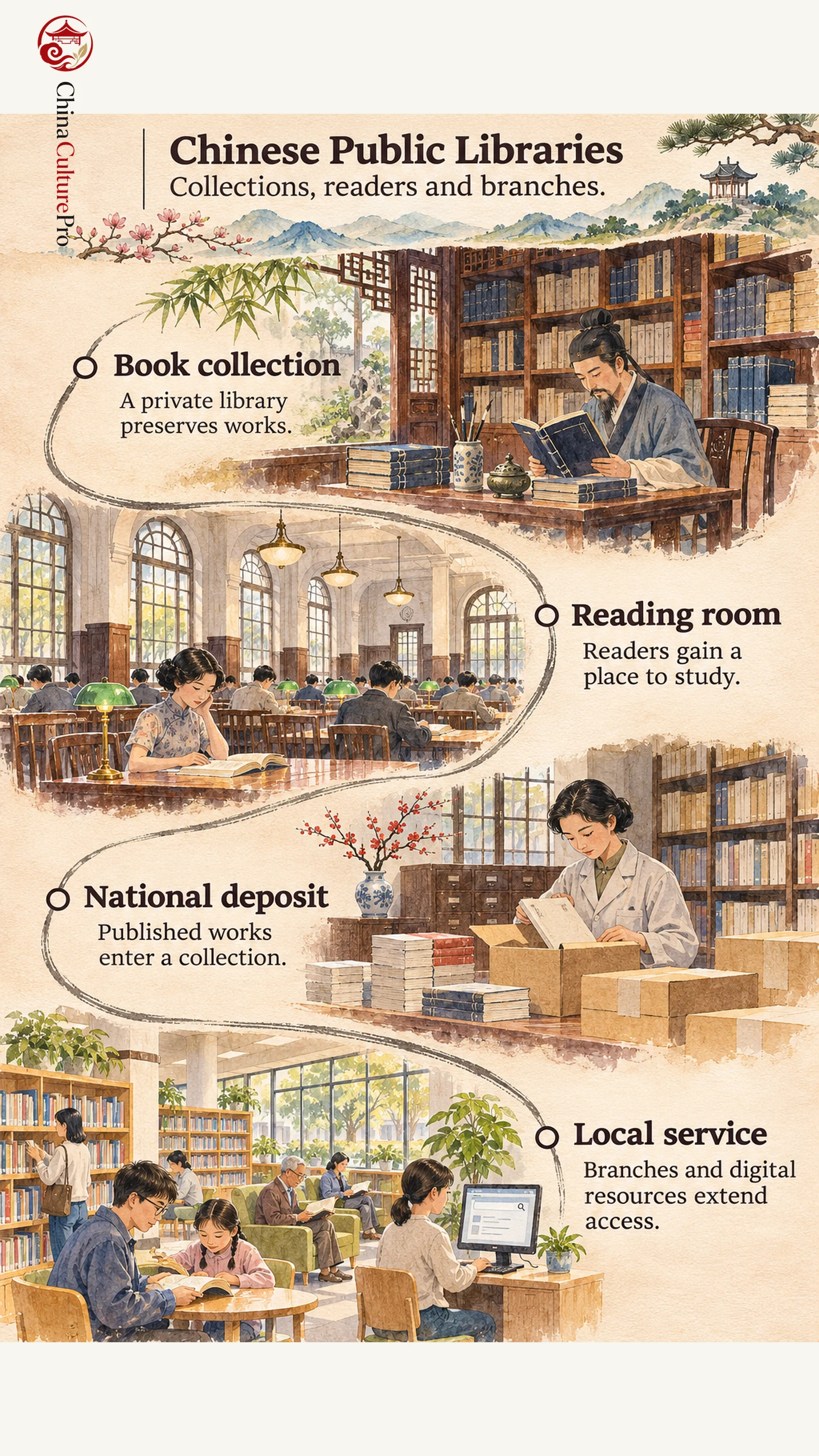
A collection can preserve books for centuries, while a reading room can serve a person who needs one book today. Chinese library history includes both purposes. The shift toward public access changed who an institution served and what it provided.[1][2][3]
Private Collections and Public Reading
Fan Qin established Tianyi Pavilion (天一阁, Tiānyī Gé) in sixteenth-century Ningbo. It was a privately maintained book repository. Its survival tells us about book collecting and preservation in Ming and later Zhejiang culture, and its later life as a museum provides another way for visitors to encounter that history.[1]
Whether a collection is historically important is a different question from who could use it at the time. A public library organizes its services around readers outside the owning household or institution. That can mean a reading room, help finding documents or rules for taking a book home.[1][4]
Two Late Qing Library Milestones
The Hubei Provincial Library traces its founding to a library established in Wuchang in 1904. The early collection was reorganized and expanded, and the institution opened fully to the public in 1905. Its own history distinguishes those two dates. It continues to hold materials such as local gazetteers and works concerning Hubei.[2]
In Beijing, the Qing government approved the Metropolitan Library in September 1909. It opened to readers at Guanghua Temple in August 1912, after the change of government. Approval came under the Qing, while readers first entered the library under the Republic.[3]
What a National Library Does
In 1916, the Beijing institution began receiving legal deposit copies of domestic publications. A deposit system gives a national collection a way to preserve material as it is published. The institution later became the National Library of China, under that name since 1998. Its work combines preservation with public access. Like Chinese museums, it can also use exhibitions to help visitors understand a collection.[3]
How Local Public Library Service Expanded
The mainland Public Library Law, adopted in 2017 and amended in 2018, provides for free basic public services and networks connecting county libraries to local branches and service points. The law also addresses mobile facilities and online resources. A reader may reach the system through a community branch, a mobile service or a digital collection. Reading rooms, community services and digital collections remain part of Chinese reading culture today.[4]
FAQs About Chinese Public Libraries
Was Tianyi Pavilion a Public Library?
It began as Fan Qin’s private repository in Ningbo. Its current museum role gives the public a way to learn about the historic collection.[1]
When Did the National Library of China Open?
Its predecessor was approved in 1909 and opened to readers on August 27, 1912. The National Library of China name dates to 1998.[3]
Which Public Library Services Are Free?
Mainland law provides for free basic services including access to reading rooms, document lookup and borrowing, and public-interest reading or educational events. Local borrowing procedures may vary.[4]
Fuentes
[1] Tianyi Pavilion and Moon Lake administration. History of the Tianyi Pavilion and Moon Lake area
[2] Hubei Provincial Library. Institutional history and services
[3] National Library of China. Introduction and history
[4] Ministry of Culture and Tourism. Public Library Law of the People’s Republic of China