

Quick Answer: What Is Chinese Manhua?
Manhua (漫画, mànhuà) is a Chinese term used for cartoons and comics. English discussions often use it for Chinese comics, including work from mainland China, Hong Kong and Taiwan. Its history includes pictorial magazines and newspaper strips as well as longer comic series and digital works.[1][10]
- Form: A brief visual joke and a continuing narrative offer different reading experiences.
- Context: Regional publishing industries shaped distinctive works and audiences.
- Reading: Check the edition’s panel order, language and layout.
A single drawing style, color scheme or reading direction cannot define this varied field.
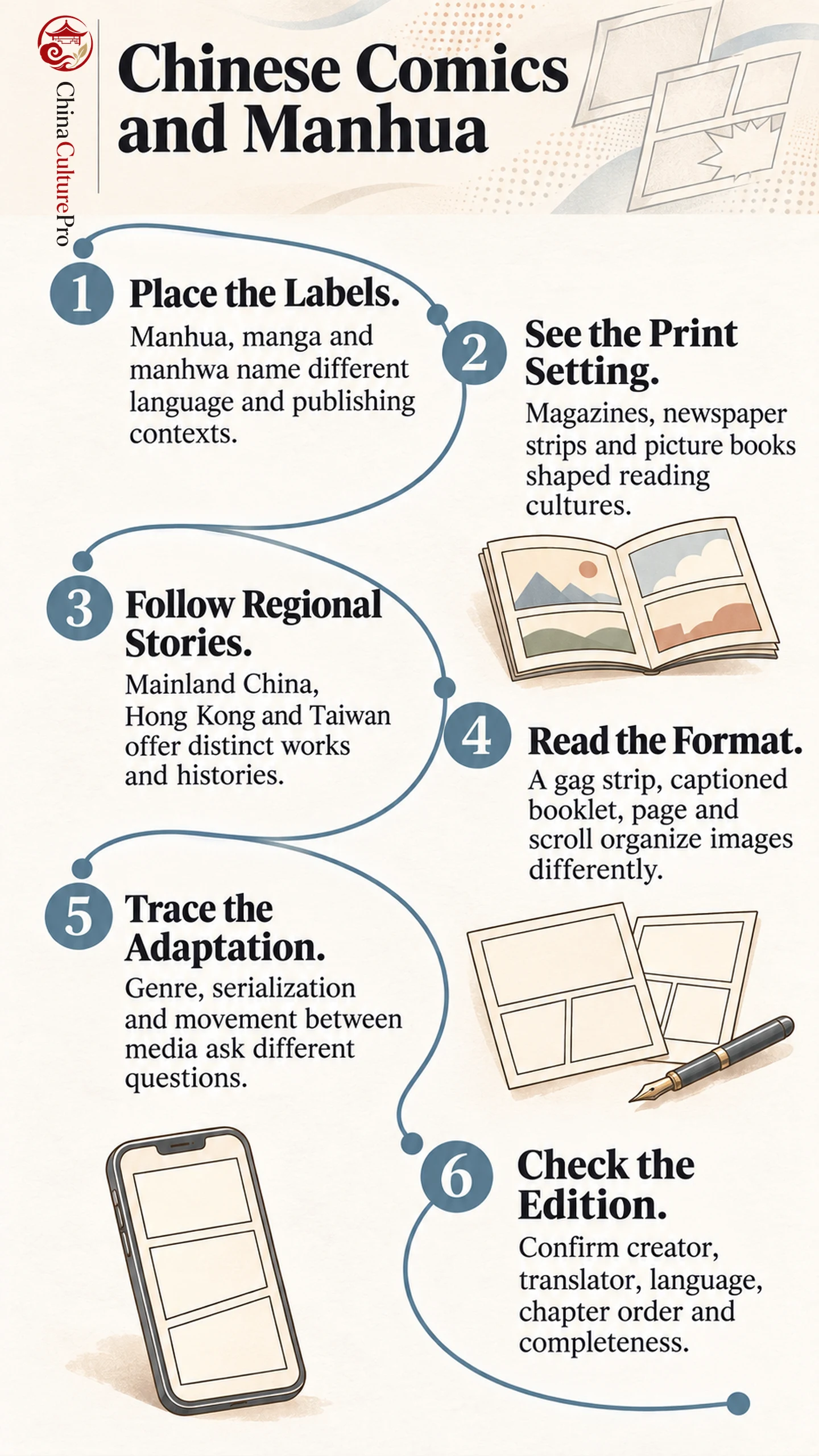
A pocket picture book, a newspaper gag and a scrolling phone comic place images before readers in different ways. Understanding Chinese comics within Chinese popular culture means following those formats alongside the histories and communities that gave them meaning.
Manhua, Manga and Manhwa: Related Words, Different Contexts
Manhua, manga and manhwa are related words used in different language and publishing contexts. English-language libraries commonly distinguish Chinese manhua, Japanese manga and Korean manhwa. These labels help locate works, but they do not tell you everything about a comic’s audience, genre or visual design.[10]
Artists, publishers and readers have long encountered work from elsewhere. A familiar character design or page arrangement can therefore reflect exchange as well as local practice. When identifying a comic, look for the creator, original publisher and language. An English translation retains a connection to its original publication history.[2][8]
Print Histories: Magazines, Strips and Picture Books
Modern manhua developed within a lively print environment. John Crespi’s research on pictorial magazines follows material ranging from 1920s Shanghai fashion drawings to wartime narratives and early socialist-era political images. A drawing’s neighbors on the page, including photographs, advertisements and other illustrations, were part of how readers encountered it. Satire, entertainment and public commentary shared that environment.[1]
Lianhuanhua (连环画, liánhuánhuà), literally linked pictures, developed as a recognizable picture-story format. Small booklets commonly pair a sequence of illustrations with captions. Their subjects included adapted fiction, folk stories, historical material and political or educational narratives. The term was used in the 1920s, and Shanghai became an important publishing center.[2]
Reading also had a social setting. Roadside stalls let readers browse or rent picture books, bringing compact printed stories into everyday urban life. Later publishing policies shaped what could be printed and distributed. The wider history of Chinese printing explains the longer relationship between reproduction, books and access to images.[2]
Mainland China, Hong Kong and Taiwan: Distinct Reading Cultures
On the mainland, Zhang Leping’s Sanmao shows how a continuing cartoon character could make social conditions visible through a child’s experience. Sanmao first appeared in 1935. Wanderings of Sanmao ran in Shanghai’s Ta Kung Pao from 1947 to 1948, presenting the difficulties of a poor orphan’s life. Read the orphan’s experiences alongside the conditions of postwar Shanghai.[3]
Hong Kong comedy comics developed memorable figures such as Old Master Q, My Boy and Sau Sing Chai. Their brief humorous situations let readers follow setups and visual jokes. Tony Wong’s Dragon Tiger Gate offers that contrasting action tradition. It later supplied the basis for Wilson Yip’s 2006 film, demonstrating how a comic property could move into another part of the entertainment industry.[4][5]
Taiwan’s comics include stories about local history and ordinary lives alongside many other genres. Ruan Guang-Min’s The Town with the Papaya Tree (2024) adapts Long Ying Zong’s fiction set during Japanese colonial rule. CCC, which began as a publishing project in 2009 and became an online platform in 2020, has supported work engaging with history, folklore, society and ecology.[6][9]
Four Formats and How They Shape Reading
| Format | Typical arrangement | Reading emphasis |
|---|---|---|
| Short cartoon or gag strip | A single image or brief sequence | Look for the setup, contrast and final visual turn. |
| Lianhuanhua picture story | Successive captioned illustrations, often in a small booklet | Read the image and accompanying narration together. |
| Page-based comic narrative | Panels arranged within printed or digital pages | Notice size, placement and what is revealed across a page turn. |
| Vertical-scroll comic | A sequence navigated down a screen | Notice how gaps, image length and scrolling control a reveal. |
Each arrangement offers a different way to organize a sequence. A digital work can reproduce a printed page or use a layout designed for a phone. Research comparing comic interfaces shows that page displays, guided views and scrolling can change how readers navigate and understand a sequence. The findings describe the interfaces, works and participants studied.[7]
Follow the actual edition’s cues. Begin where the panels, captions or publisher’s instructions direct you, and check whether a translation has changed the layout. Color and black-and-white art can both appear within Chinese comics. Neither feature identifies the entire tradition.[1][2][4]
Genres, Adaptations and Digital Serialization
Genre describes the kind of story, while format describes its presentation. Humor, romance, suspense, historical fiction and action can appear in different formats. CCC’s own description lists several of these categories. Martial-arts stories also draw on conventions explored in Chinese wuxia, but action is only one route into comics.[6]
A comic can adapt prose, become a screen production or begin as an original visual narrative. The Town with the Papaya Tree and Dragon Tiger Gate show movement in different directions. The latter’s film adaptation changes the emphasis between characters and converts drawn action into choreographed movement. Compare which characters, events and forms of movement each version emphasizes.[5][9]
Serialization releases a story in installments. Readers follow an ongoing sequence, so chapter order matters even when a platform presents an episode on its own. Serialized Chinese web novels offer another neighboring medium. Their use of written chapters differs from a comic’s panels, even when they share a title or story world. Chinese animation adds timed motion and sound. The guide to web-novel adaptations explains further changes when stories move between media.
Choosing a Work and Checking Its Edition
Choose an initial work by subject and format: a short humorous strip, a historical picture story or a longer continuing narrative. Check creator and translator credits, original publication details and whether the edition is complete. For a serial, identify the starting chapter and the sequence of volumes.
Use a publisher, library or authorized platform to confirm the work’s identity and available translation. TAICCA’s multilingual Taiwan Comic City project, for example, introduced translated samples for overseas readers. A sample does not promise a complete translated edition. Check the individual title’s language and publication information before following a series.[8]
FAQs About Chinese Manhua
Are manhua and manga the same?
They are related terms associated with different language and publishing contexts. English usage generally distinguishes Chinese manhua from Japanese manga. Artistic influences can cross those categories.
Are all manhua in full color?
No. Chinese comics include black-and-white and color work. A work’s color treatment depends on its production, format and intended edition.
Do all Chinese comics read from left to right?
Page arrangements vary by work and edition. A vertical-scroll comic proceeds down the screen, while a printed page requires following its panels and captions in their designed order.
Is manhua the same as Chinese animation?
Comics organize still images for the reader to navigate. Animation presents moving images through timed sequences. A story may be adapted between them, but the two media work differently.
Fuentes
[1] John Crespi, University of California Press. Manhua Modernity: Chinese Culture and the Pictorial Turn
[2] CrossAsia, Staatsbibliothek zu Berlin. Lianhuanhua: Chinese Comics from the 1950s
[3] National Art Museum of China. Exhibition on NAMOC’s Collection: Wanderings of Sanmao Donated by Zhang Leping
[4] Hong Kong Heritage Museum. Comic Fun for All: The Magic of Hong Kong Comedy Comics
[5] Hong Kong Film Archive. Dragon Tiger Gate
[6] Creative Comic Collection. About CCC
[7] Chen, Chen and Zheng, SAGE Open. Effects of Comic Application Interfaces on Reader Comprehension, Cognitive Processing, and Narrative Engagement
[8] Taiwan Creative Content Agency. Taiwan Comic City: Multilingual Websites for Taiwanese Comics
[9] Books from Taiwan, Ministry of Culture. The Town with the Papaya Tree
[10] Penn Libraries. Global Comics Collection