
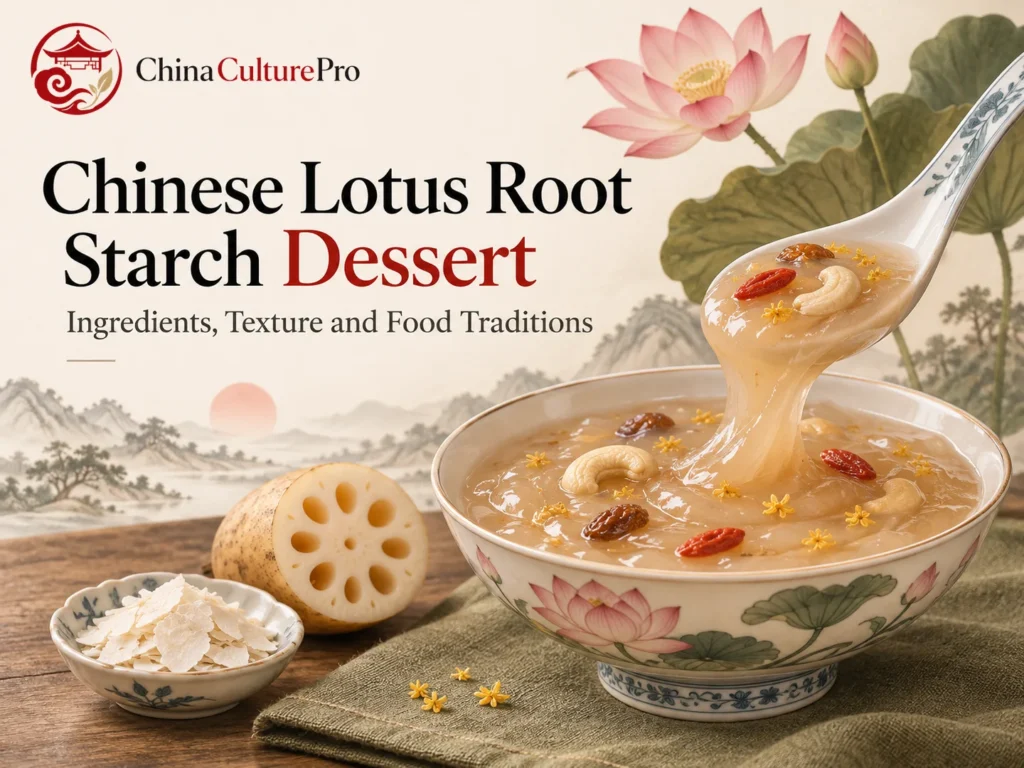

Quick Answer: What Is Lotus Root Starch Dessert?
Chinese lotus root starch dessert is a smooth, spoonable preparation made from ou fen (藕粉, ǒufěn), the starch extracted from lotus rhizomes. The dry ingredient may appear as powder or thin flakes; prepared with water and heat, it becomes a glossy, thickened paste.[1][2]
- Base: Extracted lotus starch supplies the silky body.
- Additions: Sugar, flowers, nuts and dried fruit appear in some packaged blends.
- Texture: The base is smooth; nuts and fruit introduce separate bites.
Pure starch and a ready-mixed dessert are different products. Read the ingredient list before choosing sweetness or toppings.[3][4]
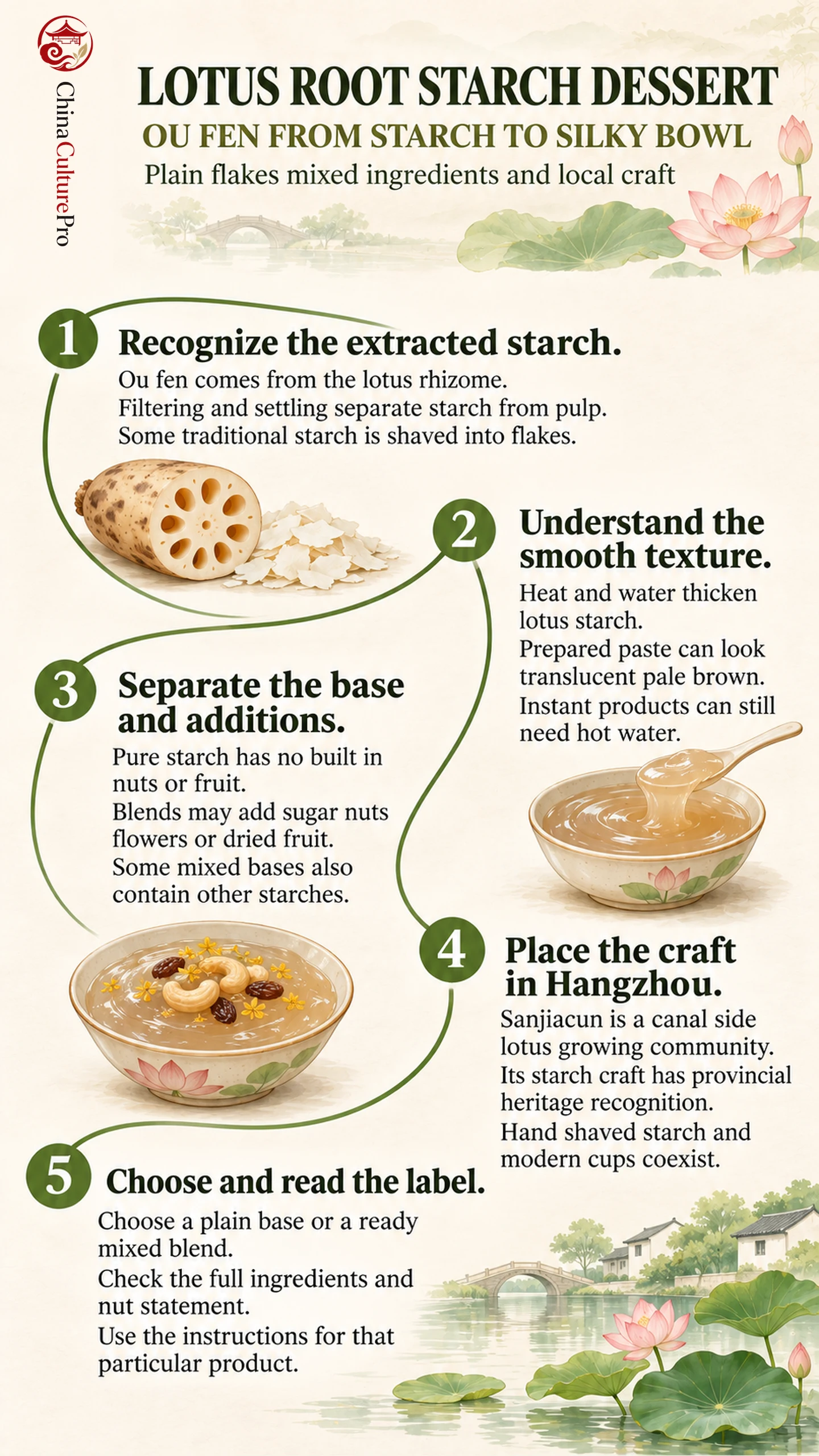
A bowl of lotus root starch dessert can look almost transparent, with nuts and fruit suspended in a glossy paste. Its smooth base comes from extracted starch. The crunchy pieces, floral aroma and sweetness depend on what has been added.
From Lotus Rhizome to Dried Starch
The edible part called lotus root is a rhizome, an underground stem. Its starch is distinct from lotus seeds. It is also a different ingredient from the kudzu starch used in Chinese arrowroot dessert.[2]
In the documented Sanjiacun craft, fresh lotus is washed and ground into pulp. Filtering and settling separate the starch from the fibrous material. The drained starch is pressed into a firm mass, shaved into thin flakes and dried. This is extraction, rather than simply drying and grinding the whole vegetable.[1]
Why the Powder Becomes a Silky Paste
Lotus starch undergoes gelatinization when heated with water, changing the mixture into a thickened paste. The thickening behavior can differ between lotus cultivars.[2]
A traditional serving has a fine, slippery texture and can be translucent pale brown. Some products call for dispersing the starch before adding hot water; one processed cup product instead uses a single hot-water step. “Instant” therefore does not tell you that cold water will work. Follow the instructions for the particular product.[1][3][5]
Pure Starch, Nuts and Sweetened Blends
Compare the base and additions in these three product forms:[1][3][4]
| Product form | Qué incluye | What changes in the bowl |
|---|---|---|
| Pure lotus starch | Extracted starch, including traditionally shaved flakes. | A smooth base without built-in nuts or fruit. |
| Nut and flower blend | Lotus starch with additions such as cashews, almonds, raisins, sugar and osmanthus. | Pieces add crunch or chew; sugar and flowers change sweetness and aroma. |
| Composite instant blend | A lotus-starch component may also include tapioca starch, glucose and other ingredients. | The thickened base and added seeds or fruit reflect the complete formulation. |
Osmanthus is a floral addition, not the source of the thick texture. Another mixed product includes red dates, sesame, pumpkin seeds and white fungus. The additions vary by product.[3][4]
Hangzhou and the Sanjiacun Craft Tradition
Sanjiacun, in Hangzhou’s Linping district, connects the food with a canal-side lotus-growing community. Local accounts describe villagers transporting lotus and starch through the canal network. The familiar “West Lake lotus root starch” name does not establish that the lotus was harvested from West Lake itself.[6]
The Sanjiacun production craft entered Zhejiang’s provincial intangible cultural heritage list in December 2016. Hand shaving is one feature of that local craft, not a requirement that every commercial product be handmade. This Jiangnan tradition now sits alongside sweetened blends and portable dessert cups, including gift-box formats.[5][6]
How to Choose and Eat Ou Fen
Choose plain starch for a smooth base, or a blend if you want fruit and nuts already included. Check both the main starch ingredient and the smaller additions: a product sold as lotus root starch dessert may include other starches and sweeteners.[3][4]
For dietary requirements, read the complete formulation and allergen statement. The two mixed-product labels list nuts. Serve the prepared paste as a spoonable sweet bowl within the broader world of Chinese sweet soups.[1][3][4]
FAQs About Lotus Root Starch Dessert
Is lotus root starch dessert made from lotus seeds?
No. Ou fen is extracted from the lotus rhizome, the edible underground stem.
Does instant ou fen dissolve in cold water?
Not necessarily. Some convenient products still require hot water. Use their own instructions.
Does lotus root starch dessert always contain nuts?
No. Pure starch has no added nuts; many ready-mixed versions contain them.
Is lotus root starch dessert the same as arrowroot dessert?
No. Lotus and kudzu are different sources, even when both desserts have a smooth starch-thickened texture.
Fuentes
[1] Peng Lifen, original Linping News workshop report, Hangzhou News. 品读临平,“藕”遇三家村
[2] Yu et al., original research abstract, Food Science & Nutrition. Structure and physicochemical properties of starches in lotus rhizome
[3] KHT Herbs & Goods, own product ingredient listing. Osmanthus Flower, Nuts, and Lotus Root Powder
[4] KHT Herbs & Goods, own second product ingredient listing. Osmanthus, Chia Seed, Nuts and Lotus Root Soup
[5] Hangzhou Shanwaishan, manufacturer-submitted FBIF product entry. 一次冲坚果鲜藕粉: One-Step Nut and Lotus Root Starch Cups
[6] Qiu Danchen and Chen Yinqiao, original Hangzhou Daily factory interview. 一碗藕粉折射一个时代变迁