


Quick Answer: What Is Chinese Ink Animation?
Chinese ink animation (水墨动画, shuǐmò dònghuà) brings qualities of brush-and-ink painting into moving images. Its classic Shanghai shorts combine painterly design with animation, photography and sound. The result can suggest ink spreading or a painted creature coming alive, while requiring carefully organized film production.[3]
- Look: Soft edges, tonal washes and visible brush-like forms can replace firm outlines.
- Craft: Drawings, layers, movement and camera work create the screen image.
- Viewing: Watch how figures, open space and music work together.
This is one important part of Chinese animation, with later artists developing different digital approaches.[6][9]
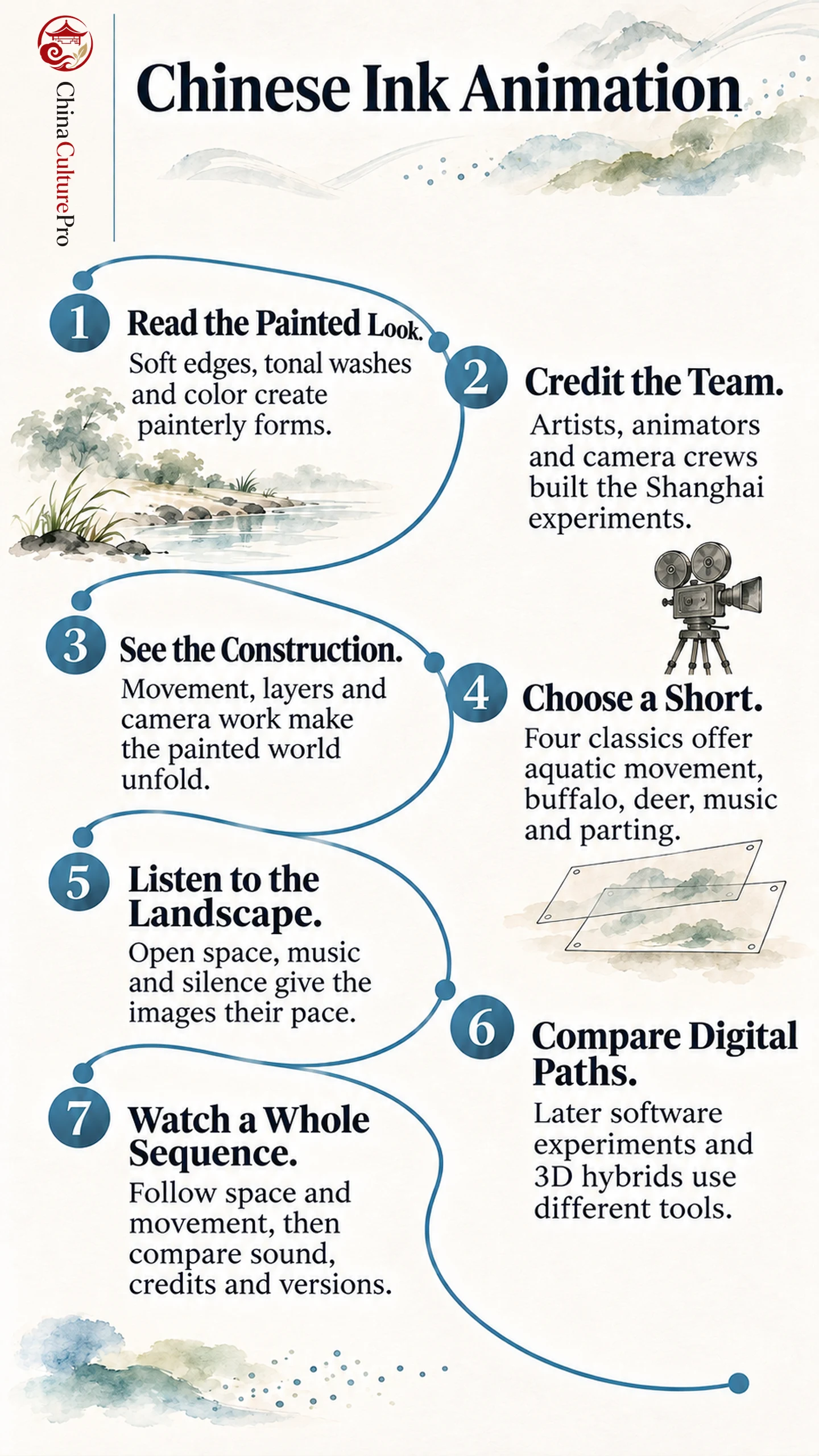
A few marks become a swimming creature; a landscape seems to open as the camera moves. Chinese ink animation makes painted forms behave in time. Its appeal becomes clearer when you look beyond a beautiful still and follow how an entire sequence develops.
The Painted Look: Ink, Wash and Color
Ink-wash painting (水墨画, shuǐmòhuà) offers a visual language of changing ink density, fluid edges and marks that can suggest a subject without enclosing every contour. The guide to Chinese ink painting explains those materials and traditions. Animation makers translated selected qualities into forms that could move and remain recognizable from image to image.[8]
The films also use color. The aquatic world of Little Tadpoles Look for Mama has colored washes, while Feeling from Mountain and Water often places greater emphasis on tonal ink and open space. The changing palette is part of each film’s visual design.[7]
A Collective Experiment at Shanghai Animation Film Studio
Little Tadpoles Look for Mama (1960) emerged from experiments at Shanghai Animation Film Studio. Its creatures draw on the visual world of Qi Baishi. The story follows tadpoles encountering other animals while searching for their mother. Painting, a children’s narrative and technical experiment came together in the production.[2]
Camerawoman Duan Xiaoxuan’s account describes collective work across animation and photography departments. She identifies Te Wei’s role in art direction, Qian Jiajun’s in technical direction and Tang Cheng’s coordination of animators. That division of labor matters: the film’s continuity and delicate appearance depended on several kinds of expertise.[1]
The studio’s experiments developed local visual approaches within a state-supported industry. Political pressures later interrupted careers and production, followed by renewed work in the 1980s. Changing institutions shaped the work alongside its artistic goals.[3]
How Drawings Become Moving Washes
A painted image offers the starting design. Animation requires successive states of movement; photography organizes those elements into a sequence that can be projected. The practical challenge is keeping a figure recognizable while maintaining the delicate variations that make it look painted. The sequence depends on deliberately organized changes between images.[3]
Duan recalls that the makers of The Herd Boy’s Flute studied Li Keran’s model paintings and divided the image into multiple layers. The painted buffalo’s ink effects were more complex than those in the earlier tadpole film. This was a process of analysis and reconstruction, drawing on the techniques of Chinese painting while solving problems specific to animation.[1]
Research on Duan’s cinematography shows how camera movement makes layered landscapes unfold over time. Follow changes of viewpoint, distance and rhythm alongside the movements of a character.[3]
Four Short Films and What to Watch For
| Short film | Directors | Viewing focus |
|---|---|---|
| Little Tadpoles Look for Mama (1960) | Te Wei, Qian Jiajun and Tang Cheng | Notice how small aquatic figures remain distinct within delicate washes.[2] |
| The Herd Boy’s Flute (1963) | Te Wei and Qian Jiajun | Follow the changing relationship between the boy, buffalo, music and landscape.[2][3] |
| The Deer’s Bell (1982) | Tang Cheng and Wu Qiang | Watch how care for a young deer develops into the emotion of parting.[5] |
| Feeling from Mountain and Water (1988) | Te Wei, Ma Kexuan and Yan Shanchun | Watch a musician and young learner’s encounter through music and landscape.[4][8] |
English titles vary across programmes. The 1960 film also appears as Where Is Mama?, and the 1988 film has several Mountain and Water title variants. The year and credited makers help identify the same work. These four shorts provide a compact route through several phases of the Shanghai tradition.[7]
Landscape, Music and Silence
Shanshui (山水, shānshuǐ), literally mountain and water, names a landscape-painting tradition that helps explain the spatial world of these films. Open areas can suggest mist or water and let a small figure’s movement become especially noticeable. Chinese landscape painting provides further context for reading relationships between filled and open areas.[8]
In Feeling from Mountain and Water, the guqin (古琴, gǔqín), a seven-string zither, connects an older musician and a young learner. The instrument is part of their relationship and the film’s emotional progression. The separate guqin guide explains its musical and cultural history.[8]
Listen to the intervals around the music as well. Wind, other environmental sounds and silence give passages their own pace. A sequence may let the viewer dwell in a landscape before another action begins. Still images alone cannot convey those changes of duration and sound.[4][7]
Digital Continuations and Hybrid Styles
Later artists continued to explore ink-derived animation. Ann Leung’s interview-based history of Hong Kong animation describes Buck Mok and Roger Ho’s Farm Boy Azhi (2002), made through software experiments. Such work approached an ink-derived appearance through a different production environment.[9]
Deep Sea (2023), directed by Tian Xiaopeng, offers a more recent hybrid. Research describes its particle-ink approach within a 3D animated feature. Digitally generated forms evoke fluid ink effects while sharing the image with modeled characters and other techniques. Compare its fluid effects with the Shanghai shorts while paying attention to the different tools and visual system.[6]
The broader guide to Chinese animation covers other media and styles. Use the credits and production accounts to connect a film’s appearance with its makers and tools.
How to Watch an Ink-Animation Short
Begin with one short and watch it as a moving sequence. Notice where the frame is dense or open, how a figure enters that space and when the viewpoint changes. Then listen to a passage with particular attention to the relationship between movement, music and pauses.
Check the year, credits, soundtrack and subtitles when comparing versions. Narration, music and environmental sounds give each film its own listening experience.[7]
FAQs About Chinese Ink Animation
Is ink animation the same as all Chinese animation?
No. It is one part of a broader history that also includes cel animation, puppets, paper-cut approaches and digital work. An individual production can combine techniques.
Is Chinese ink animation always black and white?
No. Ink animation can include colored washes as well as near-monochrome passages. Look at the palette of the specific film.
Is it made by filming ink spreading on paper?
Classic productions involved animation and photography, including work with layered images. Their moving ink-like appearance was constructed through film processes rather than simply recording a painted sheet.
Did ink animation end with the classic Shanghai shorts?
No. Later work includes software experiments and digitally produced hybrids. These continue an interest in ink aesthetics through production methods that can differ substantially from the classic shorts.
Fuentes
[1] Duan Xiaoxuan, Association for Chinese Animation Studies. Walking Our Own Path and Making Innovations in Chinese Animated Filmmaking
[2] Hua Li, Association for Chinese Animation Studies. Animating Science and Technology: From Little Tadpoles to the Space Monkey (1950s–1980s)
[3] David John Boyd, Journal of Chinese Cinemas. Liquid Perception in Chinese Ink-Wash Animation: Duan Xiaoxuan’s Cinematography in The Herd Boy’s Flute (1963)
[4] Annecy International Animation Film Festival. Feeling from Mountain and Water
[5] Odyssey Chinese Cinema. The Deer’s Bell
[6] Whyke, Zhu and Wang, Animation. Dematerialization and Digital Ink-Painting Aesthetics in Contemporary Chinese Animation: Redefining the National Style in Deep Sea (2023)
[7] British Film Institute, Sight and Sound. Te Wei, Founding Father of Chinese Animation
[8] Yuxin Chen, Columbia Journal of Asia. High the Mountain, Long the River: Chinese Landscape Painting and Its Afterlife in the Short Animation Film Feeling from Mountain and Water (1988)
[9] Ann Y. Y. Leung, Association for Chinese Animation Studies. A Brief History of Ink-Painting Animation in Hong Kong