

Quick Answer: What Are Chinese Custard Buns?
Chinese custard buns(奶黃包,nǎihuángbāo)are sweet filled buns associated with Cantonese dim sum. Nai wong bao is a Cantonese menu spelling, distinct from the Mandarin pinyin.[5]
- Wrapper: Soft, raised wheat dough, usually steamed in this dim sum style.
- Center: Sweet egg-and-milk custard, often enriched with butter.
- Texture: A yielding bun around a creamy filling that can hold its shape.
- Serving: Enjoyed warm as a sweet dim sum or snack.[2]
A custard bun does not automatically have a flowing salted-egg center.[4]
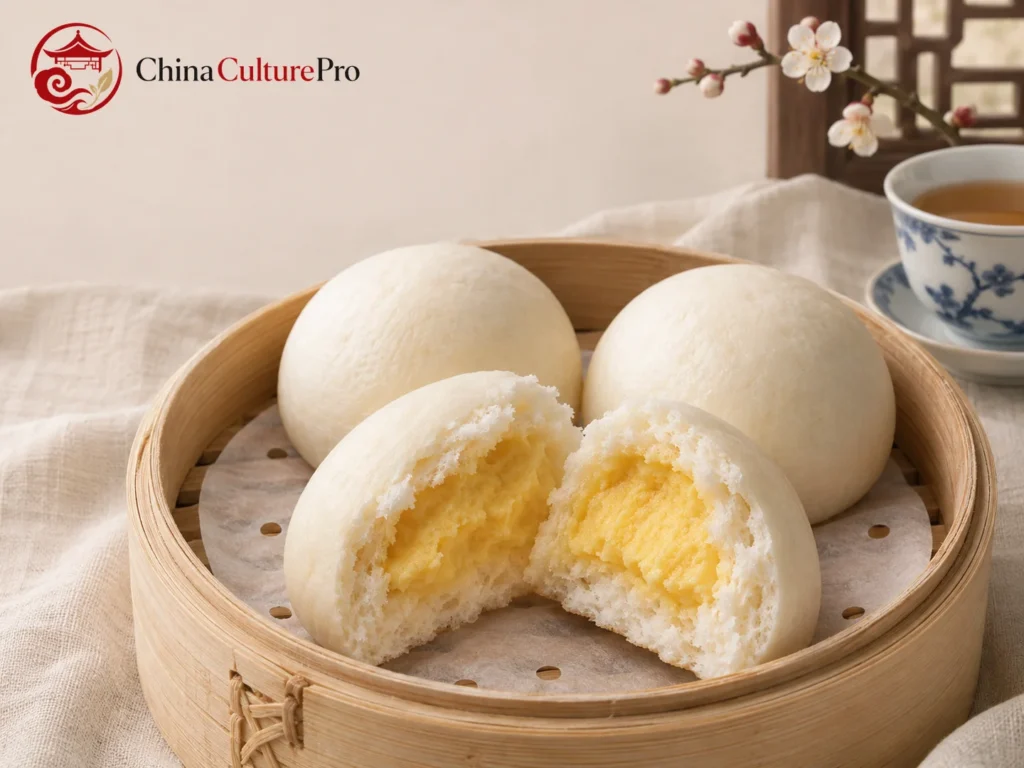
Break a pale bun open and a yellow center appears. Its consistency, more than its color, tells you which kind of custard bun you have chosen.
The Wrapper and the Egg Custard Filling
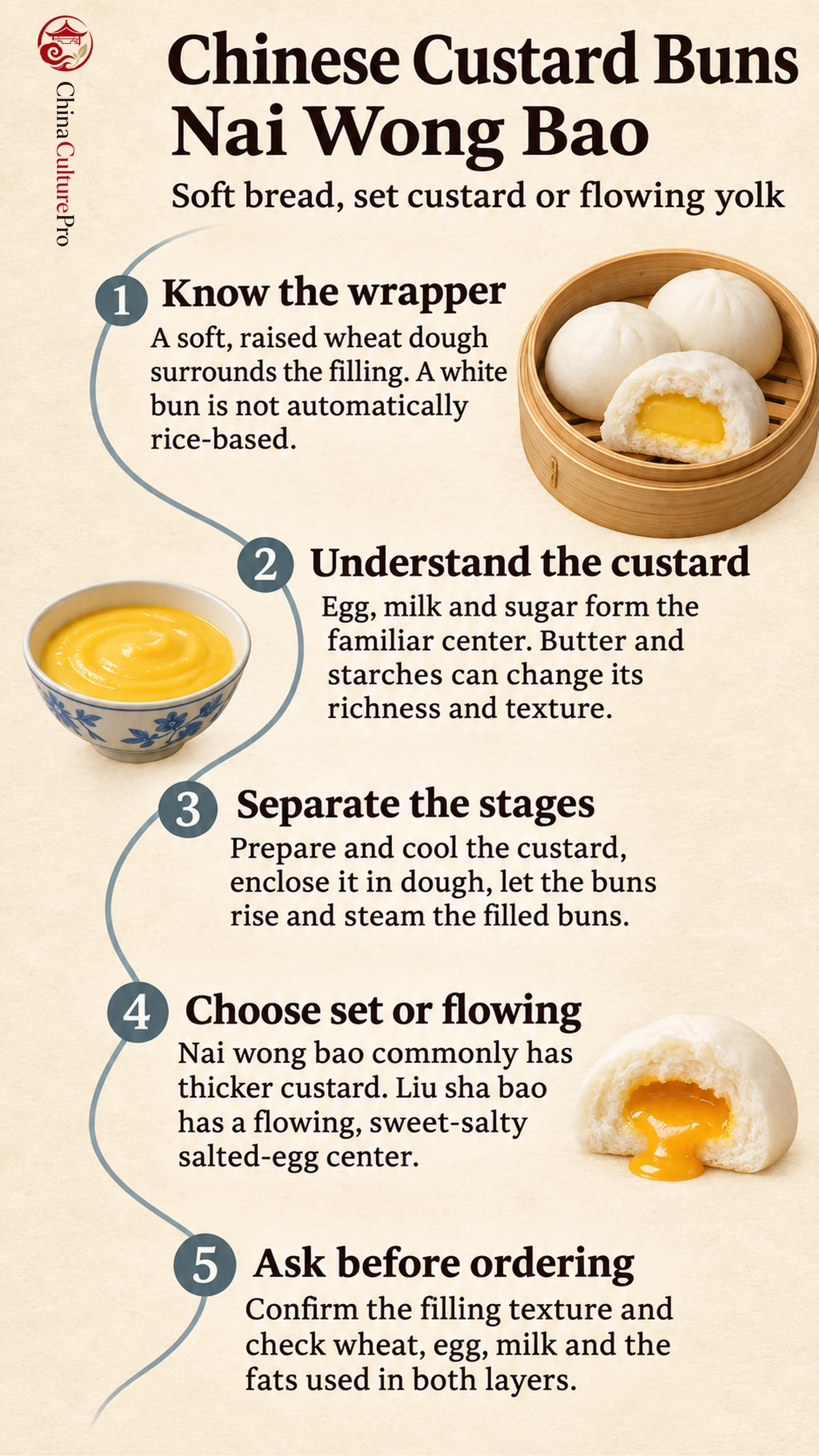
The wrapper and filling are prepared separately. The bun starts with wheat dough raised with yeast; some formulas also use wheat starch or baking powder. A pale surface and fine crumb describe its appearance, not a rice-based wrapper. Different flours and dough methods produce different degrees of softness and chew.[3]
Inside, egg, milk and sugar provide the recognizable custard flavor. Butter adds richness, while flour or starch helps thicken the mixture. Published variations use milk powder, condensed milk, coconut cream or custard powder, but these additions are not one compulsory ingredient list.[1]
The aim of a set-custard version is a smooth, tender center, firm enough to portion before wrapping yet soft when eaten. It can look slightly crumbly when broken apart without being dry. The yellow filling should be read together with its texture; color alone cannot identify salted egg or a molten center.[2]
How Custard Is Enclosed and Steamed
Custard preparation and final bun steaming are separate stages. The filling can be thickened on the stove or cooked by steaming before it is cooled and enclosed.[1][3]
- Prepare a sweet egg-and-milk custard and let it become firm enough to portion.
- Make the raised dough and divide it into pieces for individual wrappers.
- Flatten each piece, place custard in the center and close the dough around it.
- Allow the shaped buns to rise as required by the dough method, then steam them.
The finished bun encloses its filling completely. It is not a baked roll slit open for cream afterward. Paper underneath can keep the bun from sticking to the steamer; it is a serving support to remove before eating, rather than part of the wrapper.[1]
Nai Wong Bao and Liu Sha Bao: Set or Flowing?
Liu sha bao(流沙包,liúshābāo)means “flowing sand bun.” Its characteristic filling uses salted egg yolk and fat to produce a sweet-salty center that becomes fluid when warm. A faintly sandy texture is part of that style. Nai wong bao commonly has a thicker egg custard instead.[4]
| Estilo | Typical center | What to ask |
|---|---|---|
| Nai wong bao | Thicker, creamy egg custard | Is the filling set or flowing? |
| Liu sha bao | Flowing, sweet-salty salted-egg filling | Does it contain salted duck egg yolk? |
English menus may call both “custard buns.” Names can also overlap in Chinese, so asking about the center is more useful than expecting the translated label to settle everything.[4]
Custard Buns at the Dim Sum Table
These buns sit on the sweet side of dim sum, within the wider traditions of Cantonese cuisine. They can be enjoyed with tea, as breakfast, a snack or part of a shared meal. Their role is a sweet bread-and-custard bite; there is no need to wait for a formal dessert course.[2]
Warm serving brings out the contrast between soft bread and creamy filling. The bun can feel firmer after cooling, so judging a freshly steamed version and a cold one as though their textures should be identical misses that distinction.[3]
Choosing and Eating Chinese Custard Buns
Start by choosing a set or flowing center. If you want the sweet filling without the salty yolk note, ask specifically about salted egg rather than relying on the word “custard.” Some custard-bun formulations include salted egg even when the label does not say lava.[5]
For other sweet-bun options, compare Chinese cream buns, which have a different filling style, or red bean buns. Choose by the filling you want rather than treating every pale or sweet bun as interchangeable.
Check wheat, egg and milk in both dough and custard. A dough without visible egg does not make the egg-filled bun egg-free, and dairy may appear as milk, milk powder or butter. A vegetarian preference also requires checking the fats and any compound ingredients; the dish is not ordinarily vegan.[6]
FAQs About Chinese Custard Buns
Does Every Custard Bun Contain Salted Egg?
No. Regular egg custard is common, while some formulations add salted egg. Confirm the actual filling if that distinction matters to your choice.[5]
Should the Filling Flow Out When Opened?
Only if you selected a flowing style. A tender custard center that stays inside the bun is a normal result for set-custard nai wong bao.[4]
Is a White Custard Bun Gluten-Free?
No assumption is safe from its color. The usual wrapper contains wheat, and filling recipes may include wheat flour or wheat starch as well.[6]
Fuentes
[1] Ellen L. Chinese Custard Buns
[2] Kitchen (Mis)Adventures. Cantonese Steamed Egg Custard Buns
[3] Ruyi. Chinese Steam Custard Bun: Nai Wong Bao
[4] Catherine Zhang. Liu Sha Bao: Salted Egg Custard Buns
[5] Words.hk. 奶皇包/奶黃包 Dictionary Entry
[6] ANKO Food Machine. Steamed Custard Buns: Ingredients and Method