
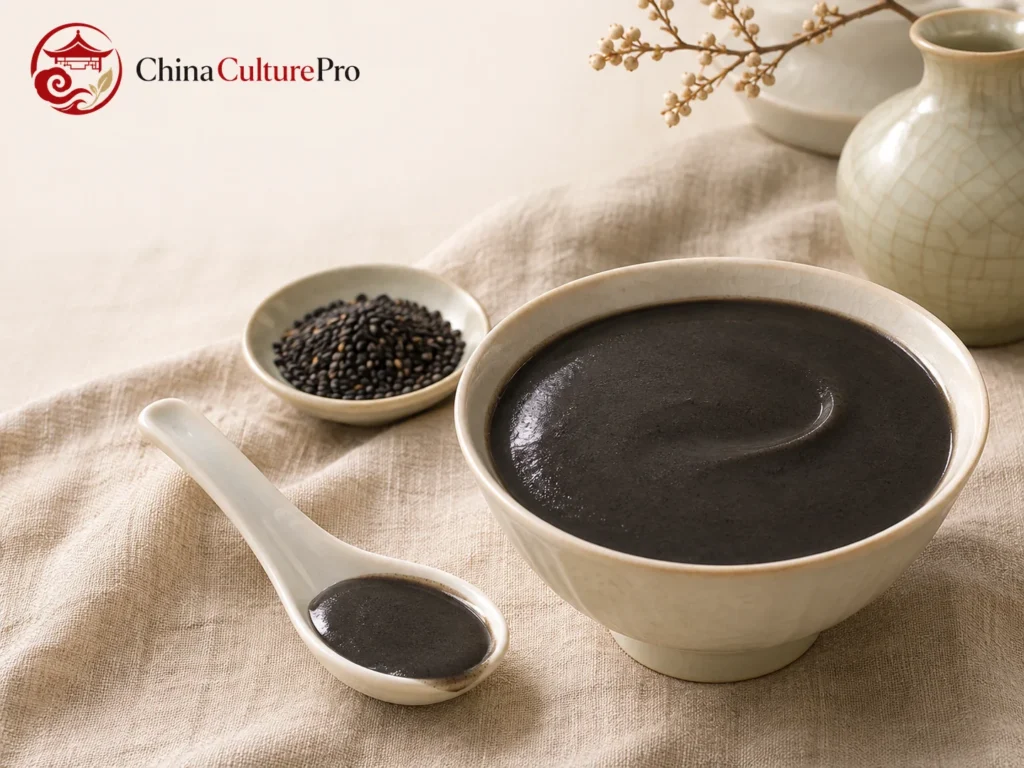

Quick Answer: What Is Black Sesame Soup?
Black sesame soup (黑芝麻糊, hēi zhīma hú) is a sweet, spoonable Chinese dessert made with ground black sesame, water, sweetener and a grain-based thickener.[1][2]
- Flavor: Roasted sesame supplies a nutty character.
- Body: Rice or rice flour helps thicken the liquid.
- Texture: The dessert flows from a spoon rather than setting into a cake.
- Serving: A warm bowl is familiar, with additions depending on the menu.
Its dark appearance does not make it chocolate, and dairy is not required in the basic preparations described here.

A glossy charcoal-colored bowl gives the dessert its distinctive first impression. Its appeal comes from sesame aroma and a smooth, gently flowing texture.
Sesame, Rice and Sweetness: Ingredient Roles
Black sesame provides the central flavor. Roasting brings out a toasted aroma before the seeds are ground. Grinding is also a texture step: fine particles feel different from a coarse, sandy mixture. A published powder-based version explicitly links the finished smoothness to the fineness of the sesame powder.[1][2]
The thickening ingredient is a separate choice. Ordinary rice flour can be cooked into the liquid, while another preparation blends already-cooked rice with the seeds. Sticky rice is one possible rice ingredient, not a requirement established by the dessert’s name.[1][3]
Water makes the ground ingredients spoonable, and sweetener balances the sesame’s roasted flavor. Sugar and rock sugar appear in published preparations; honey is used in another. Optional walnuts add a further nut flavor, but should not be mistaken for an essential sesame-soup ingredient.[1][2][3]
How the Smooth Texture Is Made
A seed-based preparation can be understood through four broad operations:[2]
- Roast the black sesame seeds to develop their aroma.
- Grind the seeds into a fine preparation.
- Combine with water, sweetener and the chosen rice-based thickener.
- Heat and stir until the mixture forms a smooth, flowing dessert.
This is an explanation of the process rather than a fixed recipe. A thicker bowl drapes from the spoon; a looser one behaves more like a conventional soup. Both textures are represented in published food writing. The result should still taste of sesame rather than requiring one universal thickness.[2]
Three Documented Preparation Approaches
“Made from sesame” does not identify the kitchen’s entire workflow. These approaches use different starting forms:
| Approach | Starting ingredients | Distinctive step |
|---|---|---|
| Roasted-seed preparation | Black sesame seeds and rice flour | Seeds are roasted and ground before the flour slurry thickens the dessert.[2] |
| Premilled-powder shortcut | Black sesame powder, rice flour and rock sugar | The flour thickens sweetened water before the sesame powder is stirred in.[1] |
| Cooked-rice blend | Roasted sesame and cooked rice, with optional walnuts | The softened grain provides body during blending; honey or sugar supplies sweetness.[3] |
These are individual documented preparations, not a ranking of authenticity. A pure ground-sesame powder is also different from a complete sweetened instant mix: knowing the starting product helps explain what else the cook must add.
Black Sesame Soup in Cantonese Dessert Culture
The dessert belongs within tong sui (糖水, tángshuǐ), the sweet-soup category associated with Cantonese cuisine. “Tong sui” is the familiar Cantonese menu spelling; the pinyin here represents the Mandarin reading of the same characters.
In Hong Kong food culture, dessert shops offer sesame soup alongside red-bean soup, tofu desserts and other sweet bowls. After-dinner visits are a documented setting, rather than a rule limiting the dessert to one meal or festival.[4]
Tangyuan (汤圆, tāngyuán), glutinous-rice balls, can be an optional addition. They introduce a chewy element to the flowing soup. The bowl should not be confused with sesame-filled rice balls served in a separate, clear sweet liquid: sesame can be the soup base or the filling inside a dumpling.[4]
Choosing and Eating Black Sesame Soup
Choose a plain bowl if you want to taste the sesame base first. Then ask about rice balls, nuts or other additions actually offered. Sweetness adjustments depend on whether the kitchen sweetens each portion separately or serves from an already-sweetened batch.
For ingredient restrictions, sesame is fundamental. Ask about walnuts, milk, other added liquids and the sweetener rather than assuming that a plain-looking dark soup has only four ingredients. Honey matters for vegan diners; optional toppings also need their own check.
Eat with a spoon and let a hot portion become comfortable to taste. One rice-flour preparation thickens further as it cools, so a bowl’s changing consistency need not mean it was originally intended as a firm pudding.[1]
Sesame also appears in baked sweets such as Chinese sesame cookies. That shared ingredient does not imply the same texture: the soup’s identity lies in its ground, liquid preparation.
FAQs About Black Sesame Soup
Is Black Sesame Soup the Same as Tahini?
No. This is a sweetened, water-based dessert with a thickening ingredient in the preparations discussed here. It is not simply concentrated sesame paste spooned from a jar.
Does It Have to Contain Glutinous Rice?
No. Ordinary rice flour and cooked-rice preparations are documented too. Ask what a particular recipe uses rather than inferring the grain from the texture.
Can Black Sesame Soup Be Vegan?
Yes, an entirely plant-based preparation is possible. Confirm the sweetener, liquid base and toppings; a recipe using honey is different from one sweetened with sugar.
Fuentes
[1] Christine Ho. Black Sesame Soup: Cheater’s Version
[2] CK Lim / Malay Mail. Zi Ma Wu: Black Sesame Paste
[3] Judy / The Woks of Life. Black Sesame Soup
[4] Hong Kong Talent Engage. Traditional Desserts and Late-Night Eateries