
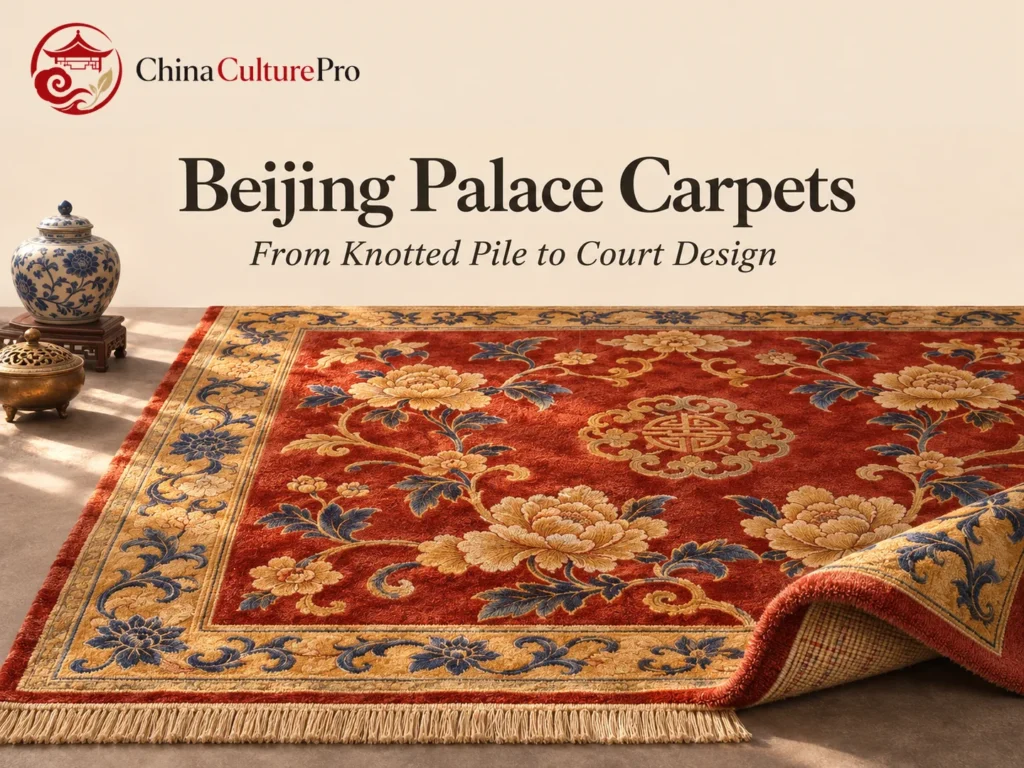

Quick Answer: What Are Beijing Palace Carpets?
Beijing palace carpets (北京宫毯, Běijīng gōngtǎn) are associated with carpet weaving for the imperial court in Beijing. In the wool tradition, hand-tied knots form a raised surface on a woven foundation. Historic court textiles also include wall hangings made with silk and metal thread. The craft continued beyond the court in workshops and factories. [1][2][3][5]
- Structure: The pile is held by a woven foundation.
- Palace use: Surviving carpets include floor coverings and wall hangings.
- Living craft: Beijing palace carpet weaving entered China’s national heritage register in 2008. [1][2][3]
The name describes a tradition with a court history. The materials and original use depend on the particular carpet. [1][2][3][4]
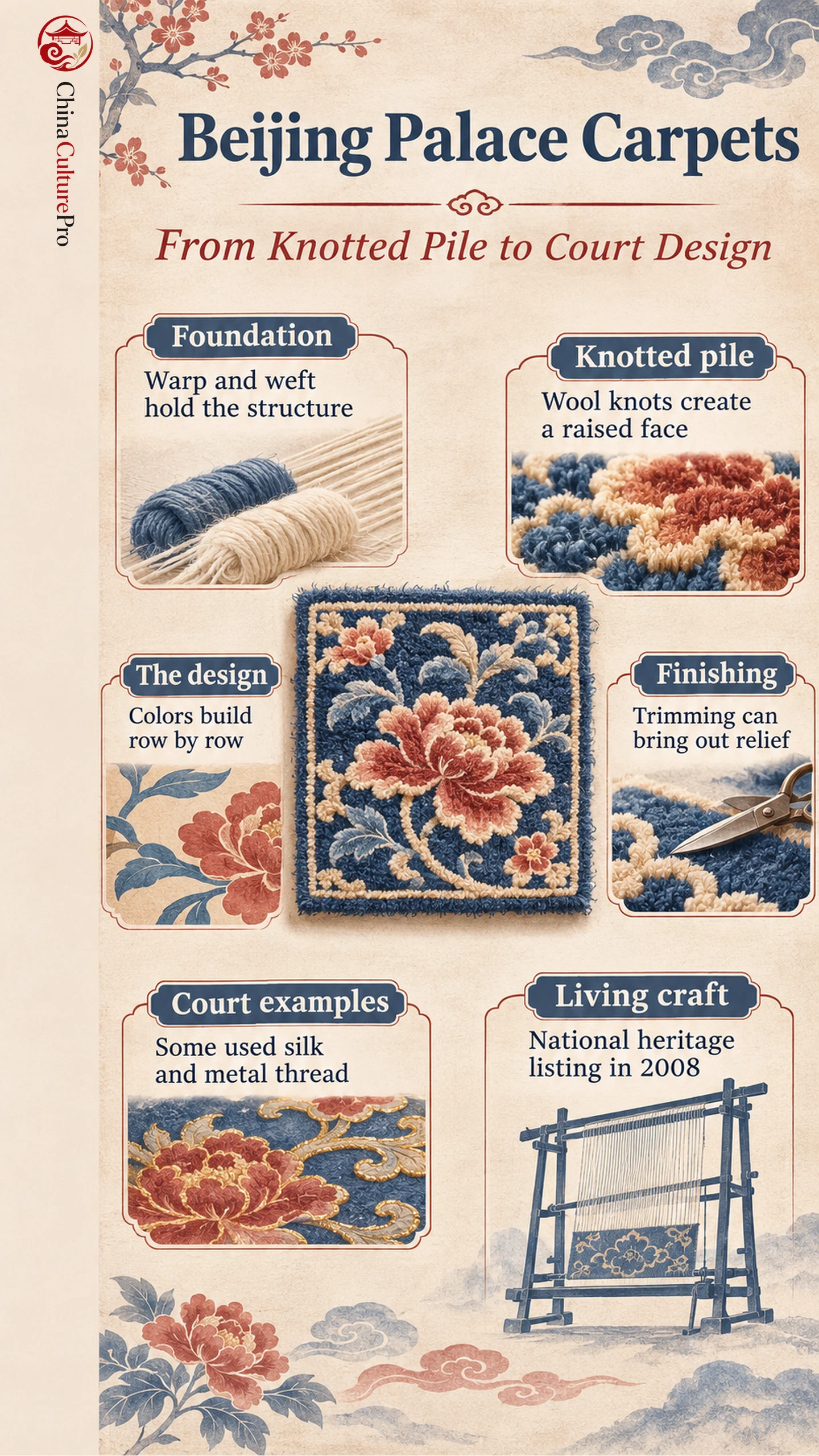
A carpet’s face shows the pattern. Its edge and its foundation can reveal how it was made, and, in some court examples, where it was intended to go.
What Holds a Hand-Knotted Carpet Together?
In the handwoven wool method described by the national heritage register, cotton warp threads run lengthwise and cotton weft crosses them. Wool yarn tied into the foundation forms the knotted pile (栽绒, zāiróng). Cut yarn ends stand above the foundation, giving the carpet a raised face. The base and the surface have different jobs and can be made from different fibers. [1]
Material descriptions matter when looking at a museum carpet. The Palace Museum preserves historic wool floor carpets and records other pieces in which silk and metal thread play an important part. The face of a carpet may show the motifs clearly. Its catalog entry is a better guide to the fibers and original use when the museum has evidence for them. [2][3]
From the Pattern to the Finished Pile
The Beijing heritage record groups the work into preparation, weaving and finishing. Preparing a design and selecting yarn colors determines how details will appear in the completed surface. On the loom, the weaver builds the design into the fabric through rows of colored pile. A change of color at a knot can turn the edge of a leaf or part of a border. Even a flowing design is assembled one row at a time. [1]
Finishing can change how the design catches light. The heritage record describes leveling the surface and, on some patterns, clipping areas so that shapes stand out in relief. The account also identifies washing and final tidying as workshop stages after weaving. The last stage therefore affects how the pattern looks as well as how the surface feels. [1]
A Qing Wall Hanging in the Palace Museum
A Qing wall hanging in the Palace Museum, made during the Qianlong reign, measures nearly 6.5 meters across. It was woven in Beijing using methods the museum associates with Uyghur carpet weaving from Xinjiang. Silk pile forms the motifs, while the museum records gold thread woven in a herringbone structure in the central ground. Magnolia, flowering crabapple, peonies and other motifs spread across the central field, arranged from a court design. [2]
The edges of other court textiles preserve a different kind of evidence. In the MGM collection, palace or hall names survive on the selvages of some pieces. Names such as the Hall of Supreme Harmony connect the object to specific interiors of the Forbidden City. The inscription is more direct evidence of destination than the motifs, which can appear in different settings. [2][4]
From Court Workshops to a Living Craft
The craft moved beyond court production. The national heritage record traces Beijing workshops into the twentieth century and describes a later period of large-scale exports. A 2018 profile of Wang Guoying (王国英, Wáng Guóyīng) records a working career that began in the factory era. The register names her as a representative practitioner and describes the importance of teaching by demonstration. [1][5]
China’s national register recognized the weaving tradition in 2008. In 2025 an exhibition at the China National Arts and Crafts Museum presented palace carpets alongside other arts in the group known as Beijing’s Eight Imperial Handicrafts. The exhibition is one documented way the weaving has been presented in public alongside other Chinese traditional crafts. [1][6]
FAQs About Beijing Palace Carpets
Were palace carpets always laid on the floor?
No. The Palace Museum preserves carpets formerly laid in palace rooms and also catalogs a wide pile wall hanging from the Qianlong reign. [2][3]
Are all Beijing palace carpets made of wool?
No. The living heritage entry describes wool knotted over a cotton foundation, while some historic court pieces include silk and metal thread. [1][2][4]
When was Beijing palace carpet weaving listed as national heritage?
The national register gives 2008, in its second group of listings. The entry recognizes the weaving technique and names representative practitioners. [1]
Fuentes
[1] China Intangible Cultural Heritage Digital Museum. Carpet Weaving: Beijing Palace Carpet Weaving
[2] The Palace Museum. Pile Wall Hanging with Silk, Gold and Silver Thread
[3] The Palace Museum. Illustrated Catalog of Carpets in the Palace Museum
[4] MGM Collection. The MGM Collection of Imperial Carpets
[5] Visit Beijing. Keeping an Old Handicraft Alive
[6] Beijing Municipal Government. 19th Beijing Arts and Crafts Exhibition Held in Beijing