
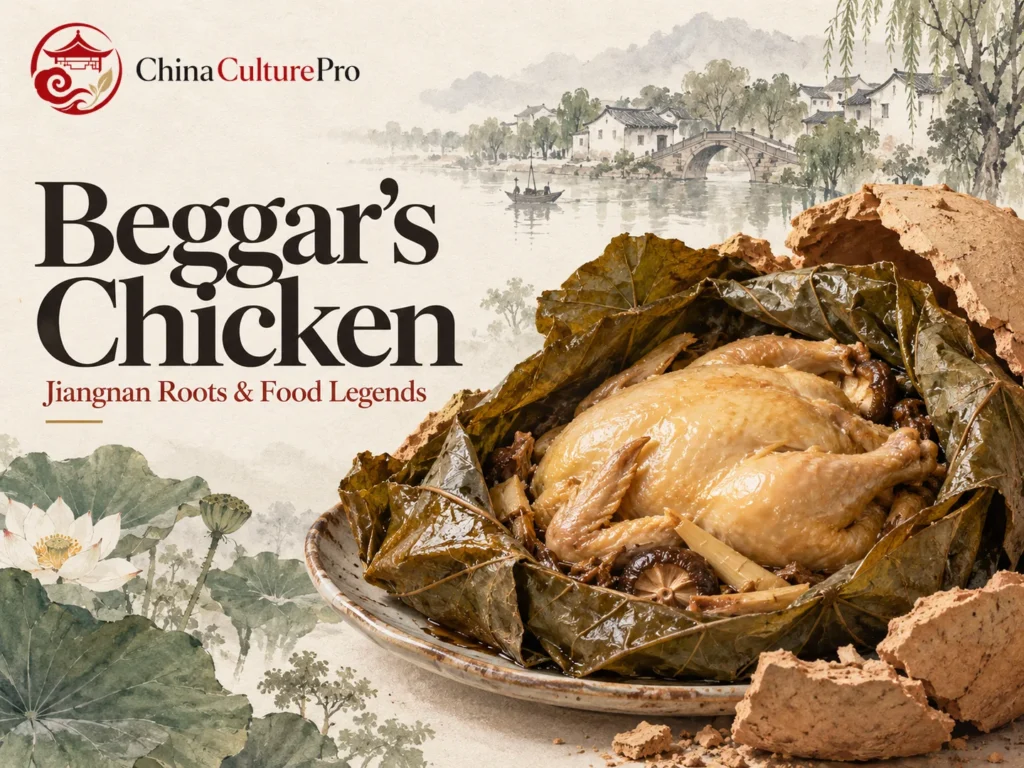

Quick Answer: What Is Beggar’s Chicken?
Beggar’s chicken (叫花鸡/叫化鸡, jiàohuā jī) is a Jiangnan whole-chicken dish cooked inside a wrapped, sealed parcel. Both Chinese spellings name the same food.
- Chicken: A whole bird, usually with a savory filling that varies by kitchen.
- Inner wrapping: Lotus leaves surround the chicken, separating it from the outer casing.
- Outer shell: Traditional versions use clay; some adaptations use dough instead.
- Serving: The parcel is opened to reveal tender meat and cooked stuffing, eaten after the wrapping is removed.
The hallmark is moist, aromatic chicken, not crisp skin. Rice is not a required filling, and the name’s origin stories belong to folklore rather than a verified invention account.

A hard shell breaks open, lotus leaves unfold, and a fragrant chicken appears inside. This memorable presentation makes Beggar’s chicken stand out among Chinese dishes. Understanding the layers also helps explain the contrast between its modest name and elaborate restaurant form.
Jiangnan Roots: Changshu and Hangzhou
Beggar’s chicken has strong associations with Changshu in Jiangsu and Hangzhou in Zhejiang, both within the lower-Yangtze cultural region known as Jiangnan. In Changshu, local craft descriptions document a stuffed bird wrapped in leaves and sealed with clay. Hangzhou menus may call the dish Jiaohua tongji (叫化童鸡, jiàohuā tóngjī), a local name emphasizing a young chicken.[1][2]
Changshu beggar’s-chicken-making skills were included in Jiangsu’s second provincial intangible cultural heritage list, announced in 2009. The recognition concerns that named local craft; it does not certify every dish sold under the English name.[3]
These records establish regional traditions, not an exclusive birthplace. A useful reading of the dish keeps both places in view: local cooks have developed their own choices of bird, filling and seasoning within a recognizable wrapped-chicken format.
Why Is It Called Beggar’s Chicken? Legends and Evidence
The familiar story begins with someone who has a chicken but no cooking pot. The person coats the bird in mud and cooks it beside or within a fire. When the hardened shell is broken, tender, fragrant meat is revealed. Some tellings leave the feathers on and have them come away with the clay.[4]
A Changshu version connects the discovery with Qian Qianyi (钱谦益, Qián Qiānyì), who supposedly encountered the dish and had it recreated with seasoning. The local account explicitly introduces this as a legend. Its publication establishes that the story is told locally; it does not prove the encounter happened.[4]
Stories involving an emperor likewise need a folklore label. They do not establish one inventor, dynasty or route into restaurant kitchens. Nor does the general idea of cooking meat in a clay covering prove that today’s stuffed, lotus-wrapped dish existed in the same form in antiquity. Modern preparation uses a cleaned, plucked chicken.
How Beggar’s Chicken Is Prepared: Leaves, Shell and Heat
The dish becomes easier to understand when its layers are separated. The filling seasons the interior, the leaves wrap the bird, and the outer casing encloses the parcel. They are different components, not one mixture.
| Componente | Typical materials | Función |
|---|---|---|
| Chicken and filling | Whole chicken; mushrooms, ham, bamboo shoots or dried shrimp | The bird is the main dish; the chosen filling adds flavor and texture. |
| Inner wrapping | Lotus leaves; some versions also use pork caul fat or food-contact paper | Leaves contribute fragrance and separate the food from the outer shell; other layers have their own functions. |
| Outer casing | Traditional clay or an adapted dough shell | Encloses the wrapped bird; clay and dough are not identical materials. |
| Heating | The complete parcel is baked or roasted | Heat cooks the food within a moist enclosed space. |
A documented Changshu method includes preparing the chicken, adding stuffing, wrapping, clay sealing and roasting as distinct operations.[1] Dough is a documented alternative casing, but its use does not make every version a bread dish.[5]
The enclosure helps retain moisture without preserving every drop. It should not be understood as a pressure cooker. The chicken and stuffing cook together inside their wrapping; the shell is not a seasoning to mix into the meat. Ingredients, extra protective layers and oven arrangements vary, so one restaurant’s construction is not a universal recipe.
What Does Beggar’s Chicken Taste Like?
Expect soft, juicy meat, with savory juices collecting inside the parcel. The leaves contribute a gentle vegetal fragrance; mushrooms can add an earthy note, while ham contributes saltiness and a cured-meat flavor. Hangzhou descriptions particularly emphasize lotus-leaf fragrance and wine aroma.[2]
Those aromas do not mean the chicken should taste of soil. A dry, hard outer shell also says little about the skin beneath it: tenderness, rather than a crisp roast exterior, is the characteristic texture. Sweetness, chili heat and how readily the meat leaves the bone depend on the version. Do not assume every kitchen produces the same balance.
Opening the Parcel and Serving the Chicken
Some restaurants open the parcel at the table; others serve it already unwrapped. For a tableside presentation, the sequence is straightforward:[1][5]
- Open the shell: Break the casing and clear away loose fragments.
- Remove the wrapping: Lift away lotus leaves, paper and ties, keeping them out of the food.
- Share the chicken: Divide the meat and cooked filling, with the collected juices or any accompanying dip.
Ask staff to help with the opening and serving. The dish fits the shared-table setting of Chinese food culture, but a hammering ceremony is not required etiquette. Lucky meanings attached to particular knocks belong to a specific establishment’s presentation.[1]
Ordering Beggar’s Chicken and Checking Ingredients
Ask about the restaurant’s version before ordering, especially if you want the unopened parcel brought to the table. Confirm these points:
- Availability and portion: Does it need advance ordering, and is it offered as a whole chicken or in other portions? There is no universal booking interval or serving size.
- Casing and service: Is the shell clay or dough, and will staff open it?
- Filling: Does it contain pork, ham, dried shrimp or scallops? Chicken as the main ingredient does not exclude other meats or seafood.[1]
- Seasoning: Check soy sauce, sesame oil, wine and any separate dip. For gluten restrictions, ask about wheat in sauces, the dough casing and shared preparation equipment.
Removing a dough shell does not by itself establish that the meal is gluten-free. Ask for ingredient details rather than relying on the dish name or its appearance.
FAQs About Beggar’s Chicken
Is Beggar’s Chicken Really Cooked in Mud?
Traditional versions use a clay casing around the wrapped chicken. Lotus leaves and any additional inner layers keep the bird separate from that shell. Some adaptations replace the clay with dough.
Do You Eat the Clay Shell or Lotus Leaves?
No. Remove the clay casing and wrapping leaves, along with paper and ties. Eat the chicken and cooked filling. A dough casing should not automatically be treated as bread; ask the restaurant.
Is Beggar’s Chicken Crispy?
Its defining texture is tender, moist meat. A brittle outer casing is different from crisp chicken skin, which is not the feature that identifies this dish.
Is Beggar’s Chicken Gluten-Free?
Not necessarily. A dough shell can contain wheat, and sauces or marinades may contain gluten. The complete ingredients and preparation environment need checking, even when the casing is removed.
Fuentes
[1] Suzhou Intangible Cultural Heritage Office. Wangsi Restaurant Beggar’s Chicken Making Skills
[2] Hangzhou official portal. Traditional Hangzhou Dish: Beggar’s Chicken
[3] Suzhou Municipal Education Bureau. Heritage in Schools Notice and Official Heritage List Appendix
[4] Changshu Municipal Government. Beggar’s Chicken: Origin Legend and Preparation
[5] Catherine Tillman. Presenting Beggar’s Chicken